How Pipe-Clamp Sensors Keep a 35°C World Cup Stadium Cool
Jun 22, 2026
On June 11, 2026, Mexico opened the World Cup against South Africa at Estadio Azteca — an open-air stadium where, according to Climate Central, the number of dangerously hot June–July days has climbed from roughly two a year to eleven since the 1986 tournament. Four of this year's sixteen venues can close a roof and chill the air. The rest cannot. In every one of the enclosed ones, the comfort that lets 70,000 people sit through a heatwave traces back to a component smaller than a thumb: a clamp-on temperature sensor on a pipe.
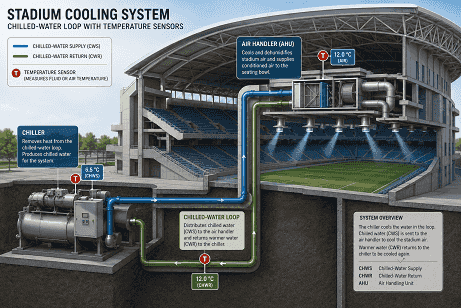
Nobody photographs these sensors. They don't appear in the broadcast. But pull one off its pipe and the chiller controlling that loop goes blind — and a blind chiller is an expensive, unreliable one. This article walks the cooling chain from the plant room to the seat, and shows where pipe-clamp sensing decides whether the system works.
Start with a figure most fans never hear. For a water-cooled chiller, every 1°F of change in chilled-water supply temperature shifts compressor energy by roughly 2 to 2.5 percent. (Consulting-Specifying Engineer; ACHR News, citing manufacturer chiller selections.) A stadium plant running several megawatts of cooling through a multi-week tournament turns that 2% into a serious electricity bill.
That is why the sensor is not a detail. ASHRAE's Guideline 22, which defines how to instrument a central chilled-water plant, makes the same point in standards language: the quality and installation of the temperature instrumentation directly bounds how accurately plant efficiency can be known or controlled. (ASHRAE Guideline 22, Instrumentation for Monitoring Central Chilled-Water Plant Efficiency.)
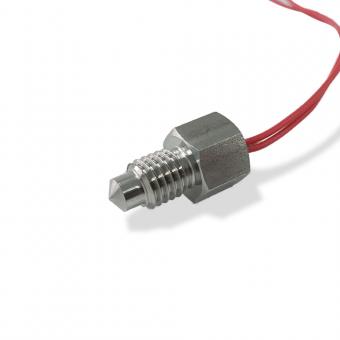
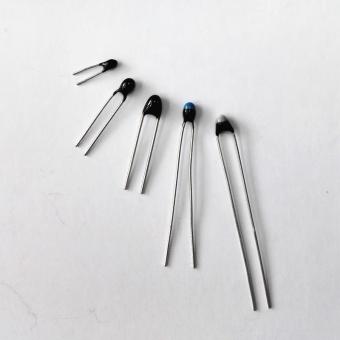
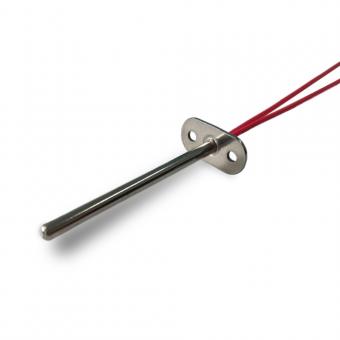
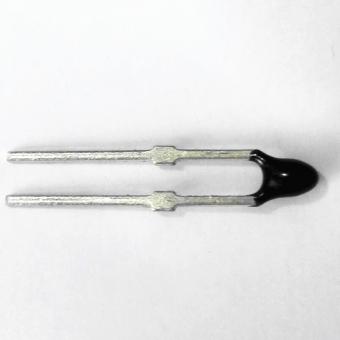
The chiller makes cold water — typically 42–45°F (6–7°C). It controls itself against two measurements above all: the water leaving it and the water coming back. Those two usually use platinum RTDs (PT100 or PT1000) because platinum drifts little and reads almost linearly, per IEC 60751. On the refrigerant side, fast and cheap wins, so NTC thermistors handle suction and discharge points. We break the plant-room sensing down in the companion piece on the 1°F that costs 2%.
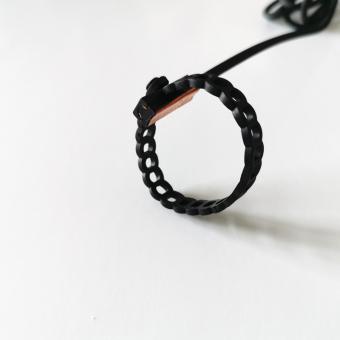
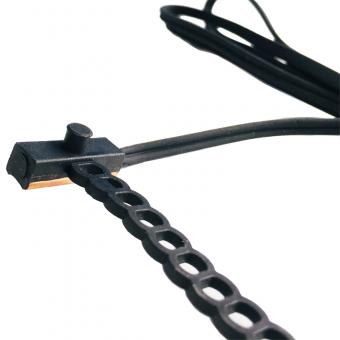
Cold water then runs through headers and branches to air handlers that push chilled air into the bowl. Each branch is worth monitoring, and here penetrating the pipe for a probe is a nuisance — so a clamp-on or strap sensor goes on the outside of the pipe instead. This is the workhorse role for an overmolded pipe sensor like the MFE1 TPE-overmoulded NTC sensor; the construction behind it is explained in our guide to TPE-overmoulded sensors.
Feeding the crowd is its own refrigeration problem — coolers, ice, and the lines that keep drinks cold. NTC thermistors govern every defrost cycle and every setpoint. That story has its own article: the cold chain behind the stadium beer line.
Finally, the players. FIFA's cooling-break decisions hang on WBGT, a heat-stress index built from three temperature sensors. We dissect it in WBGT: three sensors, one safety call.
A clamp-on sensor wraps the pipe and reads its surface — no shutdown, no plumbing, no leak path. The trade is thermal: the reading is only as good as the contact. Press the tip hard against the metal and insulate over it, and a surface sensor tracks the fluid closely; leave a gap and it drifts toward room air. The fix is mechanical, and we cover it in detail in our thermistor-mounting guide and in why your pipe sensor reads 8°F wrong.
For varied stadium pipework, an adjustable strap that fits a range of diameters beats a stack of fixed clamps. Our MFE1 strap sensor with extension chain covers pipes up to ~35 mm OD and extends beyond; the full strap-vs-clamp decision is in Article 2.
| Type | Behaviour | Job in the stadium |
|---|---|---|
| NTC thermistor | Resistance falls fast as temp rises | Pipe surface, air handlers, refrigeration coils |
| PTC thermistor | Resistance jumps past a switch point | Pump/fan motor over-temp protection |
| RTD (PT100/PT1000) | Linear, very stable (IEC 60751) | Chiller chilled-water control, plant reference |
Pick the wrong one and the system either reacts too slowly or never trips when it should. The selection logic is its own article: NTC vs PTC vs RTD, decided by the job, building on our existing sensor comparison guide.
One sensor won't cool a stadium. But every chiller, every air handler, and every cold drink in the building is downstream of one — and as the BAS-efficiency case in our "1°C deception" analysis shows, the savings a building expects usually die at the sensor, not the equipment. For a World Cup playing through record heat, the smallest component is doing some of the heaviest lifting.
No.1 XiSan Road, Electromechanical Industry Park , High&New Tech.Zone. Hefei,Anhui,China
telefone : +86-551-69109668
Whatsapp : +86-13339100504
o email : info@focusens.com
Skype : melodyliu520






 +86-551-69109668